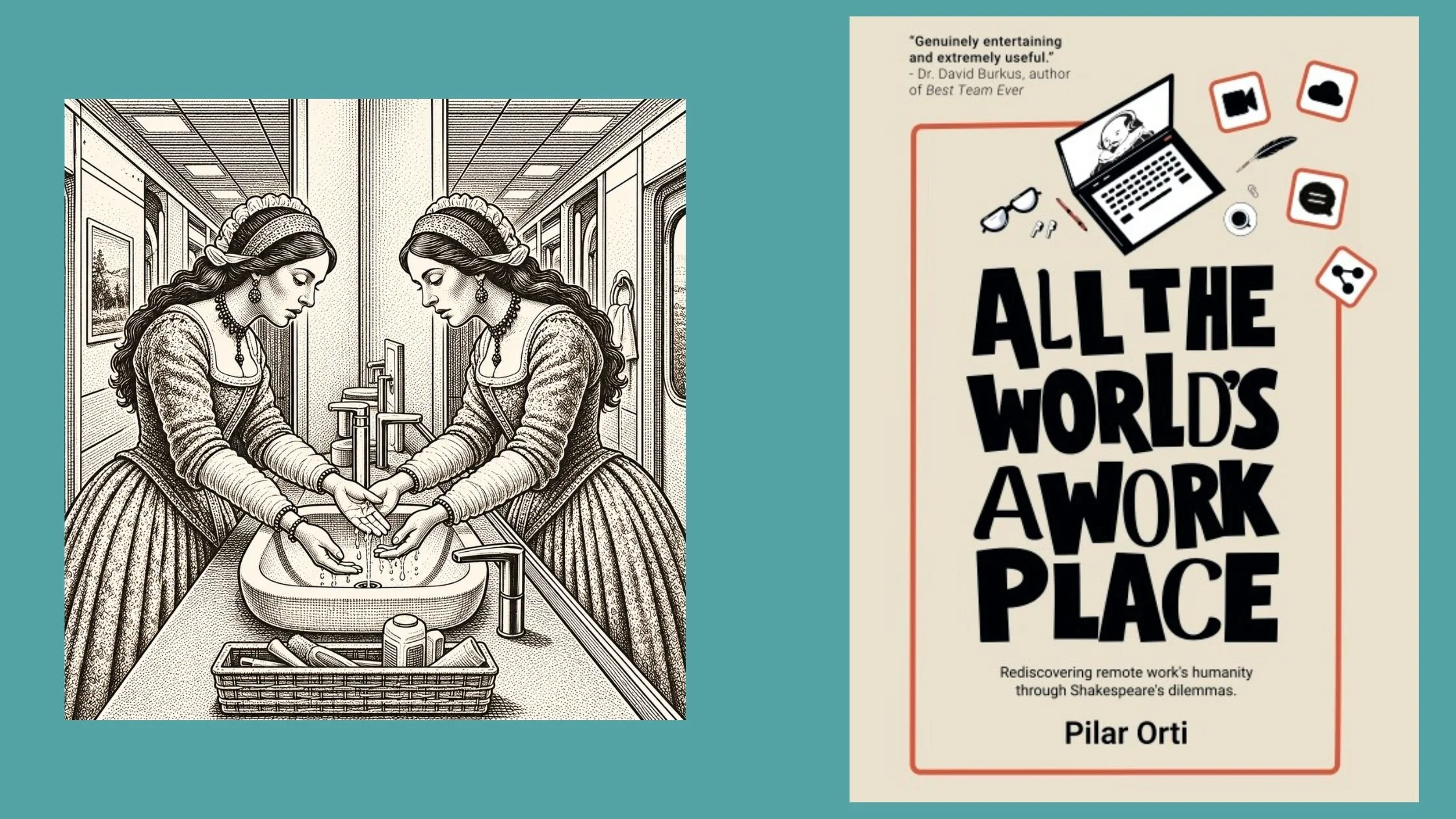
Out, damned commute! Out, I say!
I recently announced on LinkedIn the launch of the promotional campaign for All the World’s a Workplace: Rediscovering remote work humanity through Shakespeare’s dilemmas, one of my long-term connections from back in the day when remote felt exciting and groundbreaking, Phil Montero, commented:
“To commute or not commute, that is the question…”
While Phil’s dilemma had the commute centre stage, I’d opted for Hamlet to churn over whether he should work from home, or not work from home.
BUT,
One of my many previous drafts of the book had a short section on the commute, and I DID have a bit of Shakespeare illustrating a stressful type of commuter experience, featuring Lady Macbeth. I thought Phil might enjoy this short piece, but instead of sharing it only with him, I thought I’d share it with you too. I’ve also included links to three pieces of research on the commute I used for the chapter To Work from Home or Not to Work from Home, to show that there is no straight forward answer to either of our dilemmas.
(If you’re interested in the book and want to know more about how I’ve created and used “Fakespeare” as a device, read Why and how I’ve integrated Shakespeare into All the World’s a Workplace..)
Have fun!
Out, damned commute! Out, I say!—One: two: why,
then, 'tis time to do it.—Traffic is hellish!—Fie, my
lord, fie! a worker, and afeard? What need we
fear who knows it, when none can call our productivity to
account?—Yet who would have thought the old office
to have sucked so much time through it.
The commuter for life had a route: where is it now?—
What, will these hands ne'er steer again?—No more o'
that, my lord, no more o' that: you mar all with
Your commuting.
Here's the smell of the crowded bus still: all the
Disinfectant in the world will not sweeten this little
hand. Oh, oh, oh!
Wash your hands, put on your sweatpants; look not so
pale.—I tell you yet again, the office's buried; it
cannot come out on's grave.
To desk, to task! There's pinging in the chat:
come, come, come, come, give me your hand. What's
done cannot be undone.—To desk, to desk, to task!
Commute time and loneliness
The commute has been associated with all kinds of maladies. To start with, a long commute takes time away from family and social life, and can also affect us at work by, for example, increasing job strain, reduced job satisfaction, and poor task performance. Longer commutes can also lead to perceived stress, mental wellbeing, fatigue, happiness, depressive symptoms, and anxiety. A study carried out in Seoul, South Korea, also found that car commutes of over sixty minutes long were associated with “increased loneliness in relationships with both family and non-family members. The association persisted for individuals who commuted by private transport or who lived alone”.
Baek-Yong Choi, Ji-Hyeon Lee, Seok-Yoon Son, Seung-Woo Ryoo, Jin-Young Min, Kyoung-Bok Min, Association between commute time and loneliness: An analysis based on 2023 Seoul survey data, Journal of Transport & Health, Volume 43, 2025 https://doi.org/10.1016/
Health benefits of commuting
Commuting can even be good for your health! Those with options often choose healthier alternatives, like walking or cycling to work. I myself have opted to walk for 25 minutes to Shepherd’s Bush’s Underground station to get into town, instead of using my local station, which is only 5 minutes from home. This not only adds decent walking time to my trip, but often reduces the time I spend underground.
If you need scientific proof that your commute might be saving your life, there’s data for that too. A 2024 study showed that “cycling your commute can lower risk of death by 47%". This 18-year study in Scotland revealed that, compared to non-active commuters, cyclists had a 47% lower risk of death from any cause, with significantly reduced chances of cardiovascular disease and cancer. However, there was an added twist to the data, it turns out that cycling your commute can lower risk of death “as long as you aren't hit by a driver”. This is important for those who regularly cycle through traffic, as "cycle commuters were twice as likely as non-active commuters to be hospitalised due to a traffic collision".
Cycling your commute can lower risk of death by 47%, as long as you aren't hit by a driver 17 July 2024
When remote work gave rise to more commuting
Ironically, the widespread adoption of remote work might be leading to longer commutes. Having to visit the office less frequently has led many people to live outside cities, further from their employer’s headquarters. Nicholas Bloom, prominent researcher and author whose work examines the socioeconomic impacts of remote work, notes that 1 million people left US big city centres between February 2020 and June 2023. This trend, most pronounced among those in their 30s, has given rise to the “super commute”. Even the effects of increased working from home on the commuting experience are more nuanced than the headlines lead us to believe.
Golf, rent, and commutes: 7 impacts of working from home 13 March 2023
“If to be remote or not to be remote is the question, this book contains the answers. Pilar Orti repurposes Shakespeare’s knowledge of humans to help you make good choices.”